

The Lie:
- Republicans claim that their cuts to scientific research are necessary to redirect resources to strategic priorities.
Why You May Believe the Lie:
- It’s easy to agree with cutting “waste” when you are intentionally shielded from what that “waste” actually is. For example, cutting “overhead” sounds like a good idea until you understand that it includes crucial components of scientific research, such as electricity to operate sophisticated machinery.
The Truth:
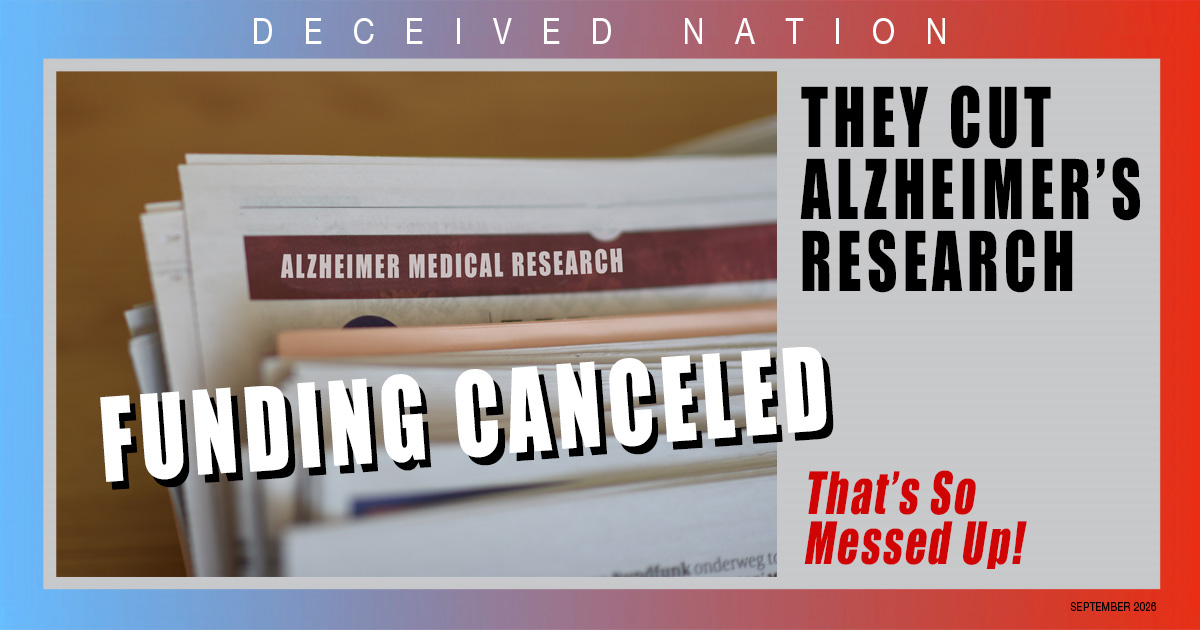
Alzheimer’s research needs sustained funding—not policies that make it harder for labs to keep the people and infrastructure needed to find a cure.
- Over the last two years, the administration has disrupted, frozen, or canceled more than 5,700 medical research grants funded by the National Institutes of Health (NIH). Following litigation from academic institutions, roughly 4,500 were reinstated. A net total of over 2,300 NIH research grants remain permanently terminated or blocked.
- The administration slashed $539 million in unliquidated obligations from active, mid-stream medical studies. Prior to 2025, the NIH had terminated fewer than six grants mid-stream over a 13-year period.
- These cuts hit Alzheimer’s patients particularly hard, as there is no cure for the disease.
Instead of cutting waste, they’re causing it.
- Clinical trials take years to build. Unlike shorter scientific experiments, tracking cognitive decline and testing new drug interventions requires tracking patient cohorts over years. If a research grant is abruptly canceled or delayed, the infrastructure supporting those patients collapses, and the multi-year timeline must often start over completely.
- According to Dr. Céline Gounder, at KFF Health News, “Cutting off funding mid-trial wastes research dollars and puts patients at risk.”
- Historically, federal scientific grants have been awarded through a rigorous system of independent, data-driven peer review. Policies that allow political appointees to bypass this process and terminate active grants for non-scientific reasons make long-term planning impossible for medical institutions and are incredibly wasteful.
- According to the National Institute of Health, it was estimated that Alzheimer’s disease and related dementias imposed $781 billion in total economic costs in 2025. This includes medical expenses, unpaid family caregiving, lost earnings and reductions in quality of life.
Action You Can Take:
- Share this post on your social media and email and discuss it with your friends.
Source & Additional Media:
- U.S. National Science Foundation, “Updates on NSF Priorities” by Sethuraman Panchanathan, Director, U.S. National Science Foundation, April 18, 2025.
- science.org, “NIH is again terminating grants that the Trump administration dislikes” by Jocelyn Kaiser, Sara Reardon, 24 JUL 2026
- The Guardian, “Hundreds of ageing Americans may not get results of Alzheimer’s study due to Trump cuts” by Jessica Glenza, 17, 2026
- The Guardian, “Alzheimer’s research centers face Trump-imposed $65m funding delay across the US.” by Jessica Glenza, March 10, 2025.
- Congress.gov. “NIH Grants Policy Under the Second Trump Administration” by Kavya Sekar, April 13, 2026.
- CBS News, “Nearly 1 in 30 clinical trials, including cancer research, affected by NIH cuts, paper says” By Kerry Breen, November 18, 2025
- JAMA Internal Medicine, “Clinical Trials Affected by Research Grant Terminations at the National Institutes of Health” by Vishal R. Patel, MD, MPH, Michael Liu, MD, MPhil, Anupam B. Jena, MD, PhD, Nov. 17, 2025.
- NIH National Institute on Aging, “NIA statement on the U.S. Cost of Dementia Model report” by Richard J. Hodes, April 25, 2025.
