

The Lie:
- President Trump and other Republican congressional leaders have repeatedly promised the American public that they would protect Medicare from budget cuts.
- Although Trump and other Republicans frequently claim that their cuts will stop illegal criminals from receiving free healthcare, that is false. Undocumented immigrants have been ineligible for Medicare since August 22, 1996, when President Clinton signed the Welfare Reform Act. But lawfully present individuals who worked and paid into the system have historically been able to qualify for Medicare benefits – including temporary protected status holders, refugees, asylum-seekers, survivors of domestic violence, trafficking victims and people with work visas.
- The GOP’s eligibility change will result in growing volumes of unreimbursed care for older patients.
Why You May Believe the Lie:
-
Rather than labeling policy changes as “cuts,” Republicans present their budget cuts as targeted upgrades designed to lower costs, expand choice, and enforce strict legal verification for public programs. The official GOP legislative platform layout from the House Ways and Means Committee explicitly frames these changes as a mechanism to deliver lower healthcare costs and “stronger taxpayer protections.” They defend stricter application freezes and enrollment parameters as essential “program integrity reforms,” and argue that measures like requiring full income and eligibility verification are not meant to harm vulnerable citizens, but rather to protect public funds by preventing structural abuse and ensuring that only strictly qualified recipients access government money.
-
Moreover, because public policy documents and legislative texts are dense, filled with complex acronyms, the true impacts remain hidden from the average consumer. Without an advanced background in federal healthcare policy, it is nearly impossible to understand how these budget rollbacks directly threaten your wallet and your family’s medical access.
The Truth:
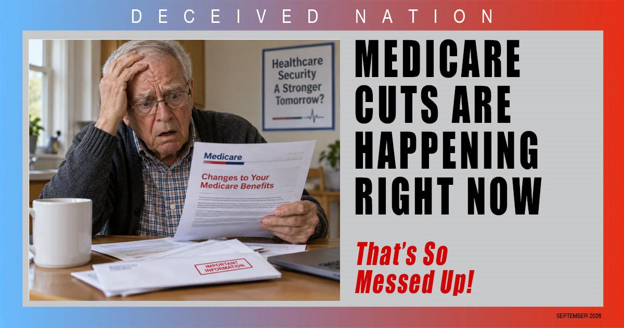
The reality is that significant cuts to Medicare are already underway. Republicans made sweeping changes that have already begun to kick in, stripping medical coverage from approximately 100,000 lawfully present immigrant seniors while simultaneously making healthcare more expensive and burdensome for the rest of the program’s 70.3 million total enrollees. The impacts will resonate far beyond the immediate beneficiary population, who face worse health outcomes from higher out-of-pocket costs and delayed treatments, and trigger economic shocks across the country.
Because the Republican “One Big Beautiful Bill” (OBBBA) adds to the national deficit without a way to pay for it, the PAYGO law forces automatic budget cuts to Medicare to make up the difference. This created an initial crisis threatening a 4% automatic cut to Medicare, which would have instantly stripped $45 billion out of the Medicare system in early 2026 alone. In late 2025, Congress passed a temporary PAYGO fix that punts the immediate crisis down the road.
Here’s a top line summary of the changes. For more details, see Deceived Nation’s Primer #3: The Federal Cuts To Medicare.
-
New Eligibility Restrictions for Immigrants: Starting January 1, 2027, 100,000 lawfully present immigrant seniors will no longer be eligible for Medicare, even if they previously paid into the system.
-
Freezing Low-Income Financial Aid: Republicans prohibited implementation of affordability rules until October 2034, blocking low-income and disabled seniors from automatically accessing Medicare Savings Programs (MSPs). This OBBBA ban disproportionately affects disabled people, as they are more likely to have lower incomes than nondisabled people. The Center for Medicare Advocacy estimates that the disruption to enrollment systems will impact 1.38 million low-income Medicare beneficiaries
-
Limits Drug Price Negotiation: Republicans are exempting more “orphan drugs” (medications for rare diseases) from Medicare price negotiations. This increases out-of-pocket costs for seniors. Making matters worse, the financial impact to seniors is exacerbated by the Trump Administration’s Summer 2026 elimination of the Medicare Part D Premium Stabilization Demonstration program. The administration’s decision to pull this federal funding forces private insurers to face rising medication costs.
-
Lowers Nursing Home Standards: Medicare pays for long-term care for over one million Americans in nursing homes. Republicans placed a moratorium on national minimum staffing requirements for nursing homes until 2035, blocking minimum staffing requirements for nursing homes that were designed to improve quality of care. Without federal enforcement, nursing homes can legally operate with fewer workers.
-
Economic Impacts: The health sector is an economic engine, representing nearly 17% of the total U.S. Gross Domestic Product (GDP). Squeezing its primary payer creates a multi-layered economic domino effect.
-
Impacts On Rural Areas: While the Medicaid cuts threaten hospitals by dropping coverage for low-income patients, the Medicare cuts act as a direct squeeze on hospital revenue.
-
Impact on the Healthcare Workforce: If Congress doesn’t implement a permanent solution, the massive $536 billion in automatic Medicare cuts will trigger severe, compounding impacts across the nation’s healthcare labor market, a crisis dramatically worsened by the Trump Administration’s termination of Temporary Protected Status (TPS). The growing staffing vacuum confronting the healthcare industry directly reduces care capacity. For aging Americans and their families, this leaves fewer care options, longer placement delays, and a lower overall quality of clinical care.
Action You Can Take:
- Share this post on your social media and email and discuss it with your friends.
Source & Additional Media:
- Trump, Donald, Truth Social, September 24, 2025
- “Fact Sheet: Undocumented Immigrants and Federal Health Care Benefits,” National Immigration Forum, September 21, 2022.
- Robertson, James A. and Sukrti Thonse, “One Big Beautiful Bill Act: An Overview of Key Healthcare Provisions and Impacts.” Greenbaum Law, September 4, 2025.
- “H.R.1’s Cuts to Medicare Remain Overlooked and Misconstrued,” Center for Medicare Advocacy. October 23, 2025.
- “Trump’s Big, Beautiful-for-Billionaires Law Triggers $536 Billion Cut to Medicare Over Next Decade,” United States Senate Committee On The Budget, August 18, 2025
- “Implementing the Harmful Republican Megabill a Timeline,” Center on Budget and Policy Priorities.” October 8, 2025.
- Khatib, Sarah, “Pay As You Go Act, Budget Law to Impact Future of Medicare Funding,” ACHI blog, November 18, 2025.
- “Pay-As-You-Go Act, Budget Law to Impact Future of Medicare Funding,” AMA, November 14, 2025.
- Pugh, Tony, Kimberly Langford, “Are People Living in the U.S. Who Aren’t Citizens Eligible for Medicare?” AARP, October 1, 2025.
- Sanchez, Vanessa G., “She paid into Medicare for years. Trump’s immigration policy will end her coverage.” NPR, April 6, 2026.
- “How Will the One Big Beautiful Bill Impact Medicaid?” USA Facts, September 24, 2025.
- Burns, Alice, “What Does the Medicaid Eligibility Rule Mean for Low-Income Medicare Beneficiaries and the Medicare Savings Programs (MSPs)?” KFF, Nov. 1, 2023.
- “The Truth About the One Big Beautiful Bill Act’s Cuts to Medicaid and Medicare,” CAP (Center for American Progress), July 3 2025.
- “How Cuts to Medicare Savings Programs Impact Everyday Americans,” Center for Medicare Advocacy, June 12, 2025.
- “Impact of the ‘Big Bill’ on Medicare,” Center for Medical Advocacy. July 24, 2025.
- Cubanski, Juliet, Tricia Neuman, “People with Medicare Will Face Higher Costs for Some Orphan Drugs Due to Changes in the New Tax and Budget Law,” KFF, October 20, 2025.
- Cubanski, Juliette, “CMS’s Decision to End Temporary Subsidies to Medicare’s Stand-Alone Drug Plans Could Mean Larger Premium Increases for Some Beneficiaries Next Year,” KFF, July 29, 2026.
- “CMS Rescinds Nursing Home Nurse Staffing Rule,” Center for Medicare Advocacy, December 4, 2025.
- Frieden, Joyce, “HHS Officially Rescinds Nursing Home Minimum Staffing Rule,” Medpage Today, December 2, 2025.
- Paulin, Emily, “Nursing Home Staffing Mandate Delayed,” AARP, July 23, 2025.
- “What Should I Do If I Can’t Pay Medical Bills?” PureMD,
- Paull, Leslie, “How will Medicare Cuts in the One Big Beautiful Bill Act Affect Rural Healthcare?” LaPorte, August 21, 2025.
- Carl Campanille, NY Nursing Homes urge Trump to preserve legal status for Haitian: ‘Unintended consequences’,” New York Post, August 17, 2026.
- “How Cuts to Medicare Savings Programs Impact Everyday Americans,” Center for Medicare Advocacy, June 12, 2025.
- “CMS Rescinds Nursing Home Nurse Staffing Rule,” Center for Medicare Advocacy, December 4, 2025.
- “Impact of the ‘Big Bill’ on Medicare,” Center for Medicare Advocacy, July 24, 2025.
- Cubanski, Juliet, Tricia Neuman, “People with Medicare Will Face Higher Costs for Some Orphan Drugs Due to Changes in the New Tax and Budget Law,” KFF, October 20, 2025.
- Cubanski, Juliette, “CMS’s Decision to End Temporary Subsidies to Medicare’s Stand-Alone Drug Plans Could Mean Larger Premium Increases for Some Beneficiaries Next Year,” KFF, July 29, 2026.
- Frieden, Joyce, “HHS Officially Rescinds Nursing Home Minimum Staffing Rule.” MedPage Today, December 2, 2025.
- Paull, Leslie, “How will Medicare Cuts in the One Big Beautiful Bill Act Affect Rural Healthcare?” Mauldin and Jenkins, August 21, 2025
- Catherman, Caroline, “TPS Expirations Spark Fears About Healthcare Worker Shortage.” Healthcare Brew, July 15, 2026.
- Bennett, Geoff, “End of migrant protections creates elder care staffing challenges,” PBS News, July 23, 2026.

